FinTech
Specialist recruitment for fintech, where finance meets risk and data
FinTech firms come to us for the talent at the intersection of finance, risk, data and regulation: credit and underwriting risk, fraud and risk analytics, model risk, compliance and RegTech, and the actuarial expertise behind insurtech. It is the hardest half of fintech hiring to get right, and it is exactly what we do best.
Why fintechs work with us
Since 2014, with deep BFSI and risk expertise, specialist in fintech credit and underwriting risk, fraud and risk analytics, model risk, compliance and RegTech, and insurtech actuarial.
Since 2014
deep BFSI and risk expertise
80%
screening ratio, candidates we submit get interviewed
85%
joining ratio, offers that become joiners
The blend
where finance, risk and data meet
The lane we own
How does EliteRecruitments help fintech companies hire?
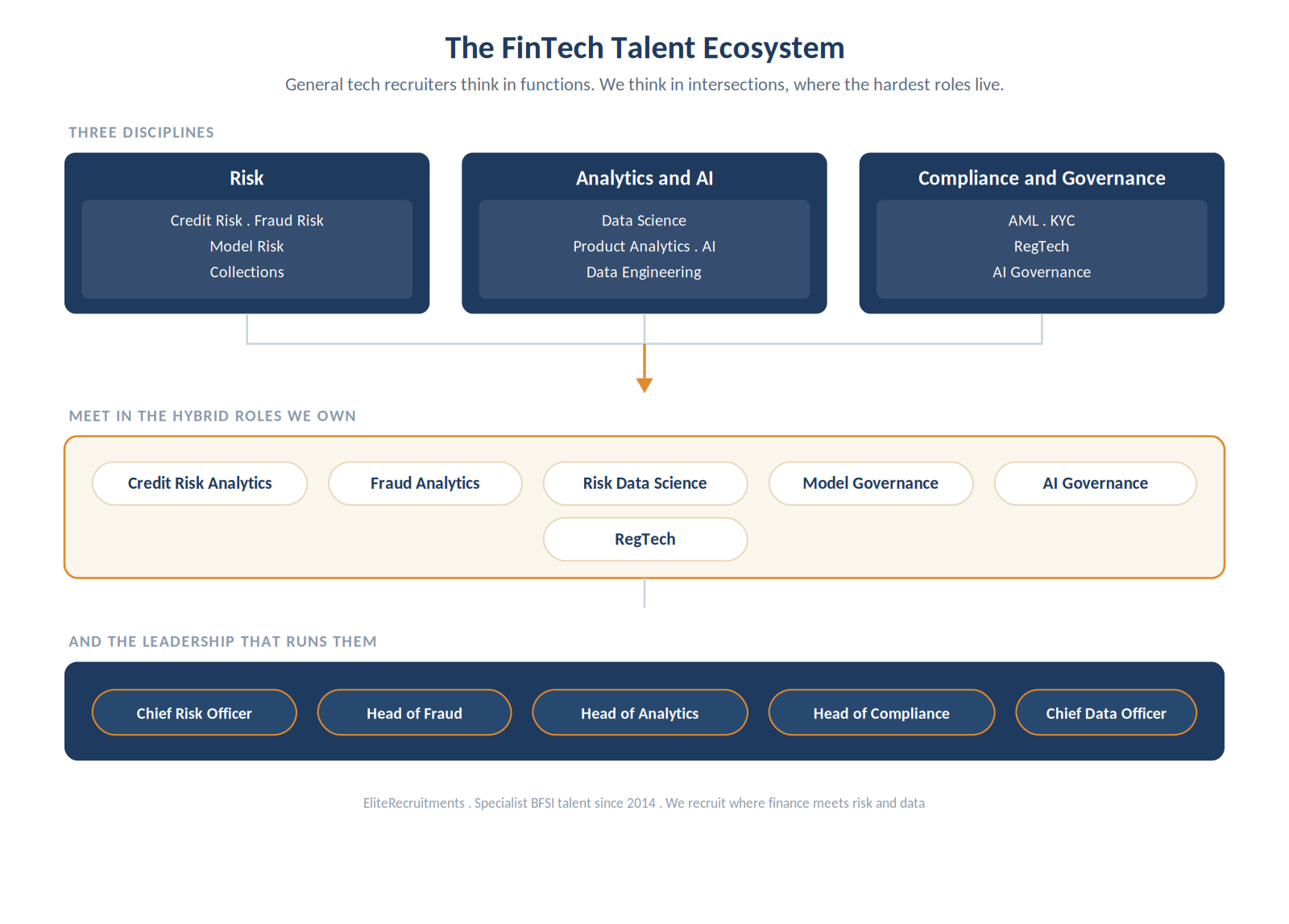
FinTech firms hire differently from traditional financial institutions. Many of their most important roles sit between disciplines rather than inside them: credit teams need analytics capability, compliance teams need technology understanding, risk teams need data expertise. So some of the hardest roles to fill are the people who combine financial services knowledge with analytical and technical capability. EliteRecruitments helps fintech firms, digital lenders, payments companies and neobanks hire exactly these blended profiles, across credit risk analytics, fraud analytics, model risk, risk data science, pricing analytics, compliance and RegTech, and the leaders who run these functions.
While the firm began in actuarial recruitment, fintech hiring increasingly sits at the intersection of risk, analytics, compliance and technology, which is one reason our work now spans these disciplines. There are excellent recruiters built entirely around the technology side of fintech, the payments engineers, the platform and product people, the blockchain specialists, and they do that work well. We are honest that this is not where our edge is. Our edge is the other half, the part that decides whether a lending business prices risk well, whether a payments firm catches fraud, whether a digital lender stays on the right side of the regulator, and whether an insurtech prices its products soundly.
This matters because the hardest fintech roles to fill are rarely the pure engineering ones. They are the ones that need someone who understands both the technology and the rules, who can build a credit model and defend it to a regulator, who can run fraud analytics and explain the risk to the board. That blend of technical and regulatory fluency is scarce and hard to assess from a CV, and it is precisely what we screen for. So rather than claim to cover all of fintech, we go deep on the part where our judgement is genuinely better than a generalist’s, or even a tech native recruiter’s.
Why it is different
Why fintech hiring is different
The growth of digital lending, payments, embedded finance and AI driven decision making is changing the shape of financial services talent. Many fintech roles now sit between traditional functions. Credit risk teams need analytics capability. Fraud teams need data science expertise. Compliance functions increasingly depend on technology and automation. AI driven products require model governance and regulatory oversight.
The result is a growing demand for professionals who can combine domain expertise with analytical and technical capability. These blended profiles are often the hardest to identify, assess and hire, which is why specialist fintech recruitment needs more than keyword matching or a traditional technology hiring approach. It needs someone who understands both sides of the role, and how they fit together.
Why FinTech talent is so hard to hire
Six pressures shape FinTech hiring. The map below shows them at a glance, and the detail follows.
Scarce blended talent
Finance, risk and tech
Model risk demand
Validate and govern AI
Fierce competition
Banks, Big Tech, consulting
Higher stakes hires
Licensing risk in play
Hiring friction
Notice periods, counteroffers
Regional pressures
Emiratisation to Bermuda
Talent supply
Scarce blended talent
FinTech’s hiring problem is no longer finding software engineers; it is finding professionals who combine finance, regulation, risk and modern technology, and that pool stays extremely small even as the industry grows more sophisticated. The hardest searches sit where those disciplines meet, with demand rising fastest for people who can validate AI models and manage model risk inside increasingly strict regulatory frameworks.
Market pressure
Competition from every direction
Traditional banks are building digital capability internally, while Big Tech, consulting firms and well funded technology companies pursue the same people with higher salaries and broader careers. Tightening regulation has meanwhile turned compliance from a support function into a strategic priority, driving strong demand across AML, KYC, financial crime, regulatory reporting, data privacy and governance.
Market pressure
Higher stakes on every hire
The shift from rapid growth to sustainable profitability has raised the stakes on every hire. Investors now expect regulatory readiness, operational resilience and disciplined growth, and a poor appointment in a regulated role can create financial, operational and even licensing risk, which forces companies to prioritise quality over speed.
Operating environment
Friction in the mechanics
Recruitment mechanics add friction of their own. Jurisdiction specific regulation limits how far compliance expertise transfers across markets, most senior candidates are passive and reachable only through specialist search, and salary inflation, long notice periods and counteroffers keep extending timelines in the major FinTech hubs.
The bottom line
Regional pressures, one shared constraint
India faces rising demand for regulated technology professionals and offshore hiring, the UK and USA report continuing shortages in AI, compliance and payments talent, the UAE combines specialist scarcity with Emiratisation requirements, and Bermuda faces niche shortages in digital assets and insurance linked FinTech. Across all of it, the industry’s greatest constraint is the same: too few multidisciplinary professionals who combine technical excellence with financial services expertise, regulatory knowledge and risk management.
The blended roles
The roles that fall between the silos
Modern fintech roles increasingly combine a functional side, such as risk or actuarial, and a technical side, such as analytics, data science or technology. Because we run deep risk, analytics and actuarial practices side by side, rather than as separate businesses, we can fill the briefs that fall between them.
Credit risk and underwriting
Credit risk modelling, decision science and the people who design who gets a loan and at what rate.
Risk and Financial AdvisoryFraud, financial crime and risk analytics
Fraud detection, transaction monitoring, anti money laundering analytics and the data science behind them.
Analytics practiceModel risk and validation
The validation and governance of the credit, fraud and pricing models fintechs increasingly run.
Risk and Financial AdvisoryCompliance and RegTech
Compliance leadership, regulatory change, KYC and AML, and the people who embed the rules into the product.
Risk and Financial AdvisoryRisk and data science
The analysts and data scientists building predictive credit, pricing and fraud capability.
Analytics practiceInsurTech actuarial and pricing
Pricing, reserving and product actuaries for digital insurers and embedded insurance.
Actuarial practiceWe understand a credit risk data scientist as both a risk hire and a data hire, an insurtech pricing lead as both an actuary and an analytics hire. For a fintech, that means one specialist partner for the cross functional roles that are otherwise the hardest to brief and the slowest to fill.
Across the sub sectors
Where our edge applies across fintech
FinTech is not one market, and our edge is stronger in some parts than others. In digital lending and credit, one of the most active parts of fintech, the demand is heavily for credit risk, underwriting, collections analytics and compliance talent, and that is squarely our home ground. In payments, the hardest hires are often in fraud, financial crime and risk, rather than the payments engineering itself, and again that is where we add the most. In wealthtech and investment platforms, the risk, analytics and compliance roles around the product are a natural fit. In RegTech, the whole business is compliance and risk, so our fit is obvious.
In neobanks and digital banking, we recruit across the risk, analytics, compliance and audit functions that any regulated bank needs, which connects closely to our Banking work. And in insurtech, the actuarial, pricing and risk side is a genuine strength, which we cover in depth on our InsurTech page. Where a fintech’s need is purely engineering, product or growth, we will say so honestly, and that is not the part of the market we lead on.
The India edge
Why India makes this lane strong
India is one of the most important fintech talent markets in the world, and the part of it that is growing fastest is exactly the part we serve. Digital lending, open banking, embedded finance, AI driven decisioning and increasing regulatory scrutiny are changing how fintech organisations operate, and these changes are driving demand for professionals who combine financial services expertise with analytical, technological and governance capability. Reported industry estimates for 2026 describe an Indian fintech sector worth in the region of 90 billion dollars and employing well over 250,000 people, with hiring tilting from generalist engineering toward hybrid profiles that combine finance and technology. As the Reserve Bank of India has tightened digital lending and KYC rules, compliance and risk professionals have become premium hires, and credit risk, underwriting, fraud and collections roles are in heavy demand across digital lenders and NBFCs.
The capability centre channel makes this stronger still. International fintechs and banks are building serious capability centres in India that do genuine fraud detection, credit scoring, model risk and compliance work, not back office support. Reported coverage describes global fintechs scaling their India centres specifically for fraud detection, payments risk and compliance driven systems, with GIFT City emerging as a regulated hub for this kind of work. For a firm whose edge is precisely risk, analytics and compliance talent, this is a powerful tailwind.
Because the capability centre story is so significant, we cover it in full on our fintech capability centre page .
Why fintech leaders choose us
Why fintech leaders choose EliteRecruitments
FinTech hiring is different from general recruitment, and even from general technology recruitment. The roles that decide whether a fintech succeeds, in credit risk, fraud, compliance and pricing, need both real domain depth and the technical and regulatory fluency to back it. Fintechs work with us because we understand these roles as connected functions rather than separate silos, because we assess genuine capability rather than job titles, and because we are honest about our lane.
Who we serve
Who we hire for in fintech
Digital lenders and NBFCs, where credit risk, underwriting, collections and compliance are the make or break hires. Payments firms, where fraud, financial crime and risk matter most to us. Wealthtech and investment platforms, neobanks and digital banks, RegTech firms, and insurtechs, across the risk, analytics, compliance and actuarial roles within each. And the capability centres where international fintechs and banks build these functions in India. We work with fintechs at every stage, from a single critical risk or compliance hire to building a function.
Most of our fintech work is in India, where our depth is greatest and where the risk, compliance and analytics demand is strongest, and we also support fintechs in the UAE, where we are active and growing, and selectively in the UK and the USA. See our India and UAE corridor pages.
How we assess
Built to assess the blend
The blended fintech roles are exactly the ones a generalist gets wrong, because they need someone who can judge both the domain and the technical and regulatory depth at once. We assess genuine capability across both sides, the risk or actuarial judgement and the data, analytics or compliance depth, before any profile reaches you. That discipline is why our placements last: we screen at an 80 per cent rate and our candidates join at an 85 per cent rate, and since 2014 we have had to return fewer than fifteen fees because a placement left early. In a market where the right blended hire is scarce and the wrong one is expensive, that means the specialist you hire is far more likely to be the right one, and to stay. See how we work
Founder led
Led by a founder who knows this work first hand

EliteRecruitments was built by Shagun Gupta, and the firm’s fintech edge sits exactly where her own expertise is deepest. She presides over all four specialist practices, with her deepest personal expertise in risk and genuine depth in analytics and audit, which is precisely the risk meets data blend that fintech hiring turns on. She built the firm to run these practices together rather than as silos, and that is what lets it fill the cross functional fintech roles others cannot. For a fintech, that means dealing with a firm whose founder understands the hardest part of the brief from the inside.
Proof
Built on the work we do best
Our proof in fintech comes from the work we already do best: the risk, analytics, compliance and actuarial hires that fintechs most struggle to fill. We have recruited credit and risk professionals, fraud and risk analytics talent, compliance leaders, and risk data scientists for banking, insurance and financial services organisations, and the same expertise is exactly what the fintech market now needs.
Credit Risk Lead
Digital lender · Bangalore
Fraud Analytics Manager
Payments firm · Gurugram
Head of Compliance
FinTech · Mumbai
Risk Data Scientist
Financial services · Pune
An illustrative fintech search
Challenge. A digital lending business needed to strengthen its credit risk and fraud analytics at the same time, against a tight market and tightening regulation. Approach. We drew on our deep risk and analytics network, screened on both domain and technical depth, and matched on long term fit. Outcome. The roles were filled across both functions, and the senior hires are still with the business and have grown in their roles more than two years on.
The future of fintech talent
As fintechs put more AI into credit, fraud, pricing and compliance, a new set of roles is emerging right in our lane: AI model risk, model governance, and the people who make sure automated financial decisions are fair, explainable and compliant. Reported industry coverage describes growing demand for AI risk and model governance roles across financial services as regulators turn their attention to AI in lending and decisioning. Because this sits exactly where risk, analytics and regulation meet, it is a natural extension of what we already do. More on our Risk and Analytics pages.
Common questions
Frequently asked questions
How does EliteRecruitments help fintech companies hire?
Does EliteRecruitments recruit fintech software engineers and product managers?
Why use a specialist for fintech risk and compliance hiring instead of a general tech recruiter?
Does EliteRecruitments help fintechs build capability centres in India?
Does EliteRecruitments cover insurtech?
Do candidates pay any fees?
Start a conversation
Talk to us about your fintech hiring
If you are hiring for the part of fintech where finance, risk, data and regulation meet, the credit risk, fraud, compliance, model risk and pricing roles that are hardest to fill, we would like to help. It is the hardest half of fintech hiring, and it is exactly what we do best.
Thank you, we will be in touch shortly.
Your note goes to Shagun and the fintech desk directly.