Banking GCC
Banking Global Capability Centres in India
A large and growing share of the world’s banking work, from credit and market risk to quantitative analytics, model validation, compliance and finance, is now built in India. We recruit the specialist talent behind banking capability centres, and we help banks build them.
Why banks hire with us in India
Specialist BFSI recruiter since 2014, with deep risk, quantitative, analytics and audit expertise, and a specialist partner for banking capability centres in India.
Since 2014
specialist BFSI recruitment
80%
screening ratio, candidates we submit get interviewed
85%
joining ratio, offers that become joiners
Risk & quant
the technical core banking centres run on
What it is, and why India
What is a banking global capability centre, and why India?
A banking global capability centre is a team a bank builds in India to run specialist banking work, from credit, market and model risk to quantitative analytics, regulatory and compliance work, finance and audit, as an integral part of its global operation rather than as an outsourced vendor. These centres concentrate on the risk, quantitative, analytics, finance and control work that modern banking runs on, rather than front office trading or origination. India leads because it combines one of the world’s largest concentrations of risk, quantitative and analytical talent with the scale to build large specialist teams, a strong cost advantage, and a maturing leadership base. EliteRecruitments recruits the specialist talent these centres rely on, and helps banks build them from the first hire upward.
Why it is different
Why banking capability centre hiring is different
Banking capability centres are no longer support operations. Many now own risk models, regulatory reporting, stress testing, financial crime controls and quantitative analytics that directly influence how banks manage capital and risk. The challenge is not finding bankers. It is finding specialists who understand highly regulated environments and can operate across risk, analytics, technology and governance at the same time. Those blended profiles are among the hardest hires in financial services, and they are increasingly concentrated in India, which is exactly where we recruit them.
The next generation
AI governance and the next generation of banking talent
Banks are increasingly deploying artificial intelligence across risk, fraud, customer operations and analytics. As they do, demand is growing for specialists who can validate these models, govern how they are used, manage regulatory expectations, and keep decisions explainable and defensible. This work sits at the intersection of risk, quantitative analytics, technology and regulation, exactly the kind of blended expertise modern banking capability centres increasingly require, and exactly the kind that is hardest to find. It is one of the fastest growing areas of banking hiring, and a growing share of it is being built in India.
The landscape
Where the world’s banking work is increasingly built
India hosts the largest concentration of banking capability centres in the world. Reported industry estimates describe well over a thousand global capability centres operating in India, employing well over a million professionals, and banking is among the largest and longest established sectors within that. The major global and regional banks run risk, quantitative, analytics, regulatory, finance and audit work from Indian centres at significant scale, not as back office support but as integral parts of how they manage risk, meet regulation and run the bank.
What began as a way to reduce cost has become something more strategic. The most advanced banking capability centres in India now house genuine expertise: credit and market risk specialists, quantitative analysts, model validators, regulatory and financial crime specialists, data scientists and the leaders who run them. For banks, the question is no longer whether to build capability in India, but how to build it well, and that depends almost entirely on hiring the right specialist talent.
The work
The banking work India centres run
Banking capability centres in India span the technical heart of the bank, the same disciplines we recruit for across our specialist function pages. Much of it sits in the risk, quantitative and analytics space where the firm is strongest.
These are not junior functions. The work is technical, heavily regulated and central to how banks measure risk, hold capital and stay within the rules. Explore the disciplines on our Risk, Analytics and Audit pages, and on our Banking industry page.
Why India
Why banks choose India
Banks build capability centres in India for a combination of reasons that few other markets offer together. India produces one of the world’s largest pools of risk, quantitative and analytical talent, with a deep pipeline of qualified professionals, including a large supply of quantitative and data skills, entering the market each year. It offers the scale to build large specialist teams quickly. It offers a meaningful cost advantage over established banking centres. And, increasingly, it offers a leadership base experienced enough to run centres of genuine expertise rather than support functions. For the risk, quantitative and analytics work at the heart of modern banking, that combination is the reason India leads.
The organisations building this capability in India span the sector: global investment banks, universal banks, corporate and commercial banks, custody and transaction banks, and credit card and payments firms, along with the risk, analytics, regulatory and technology functions that support them. The common thread is work specialist enough to demand genuine expertise, which is exactly the talent we recruit.
The maturity journey
How banking capability centres typically evolve
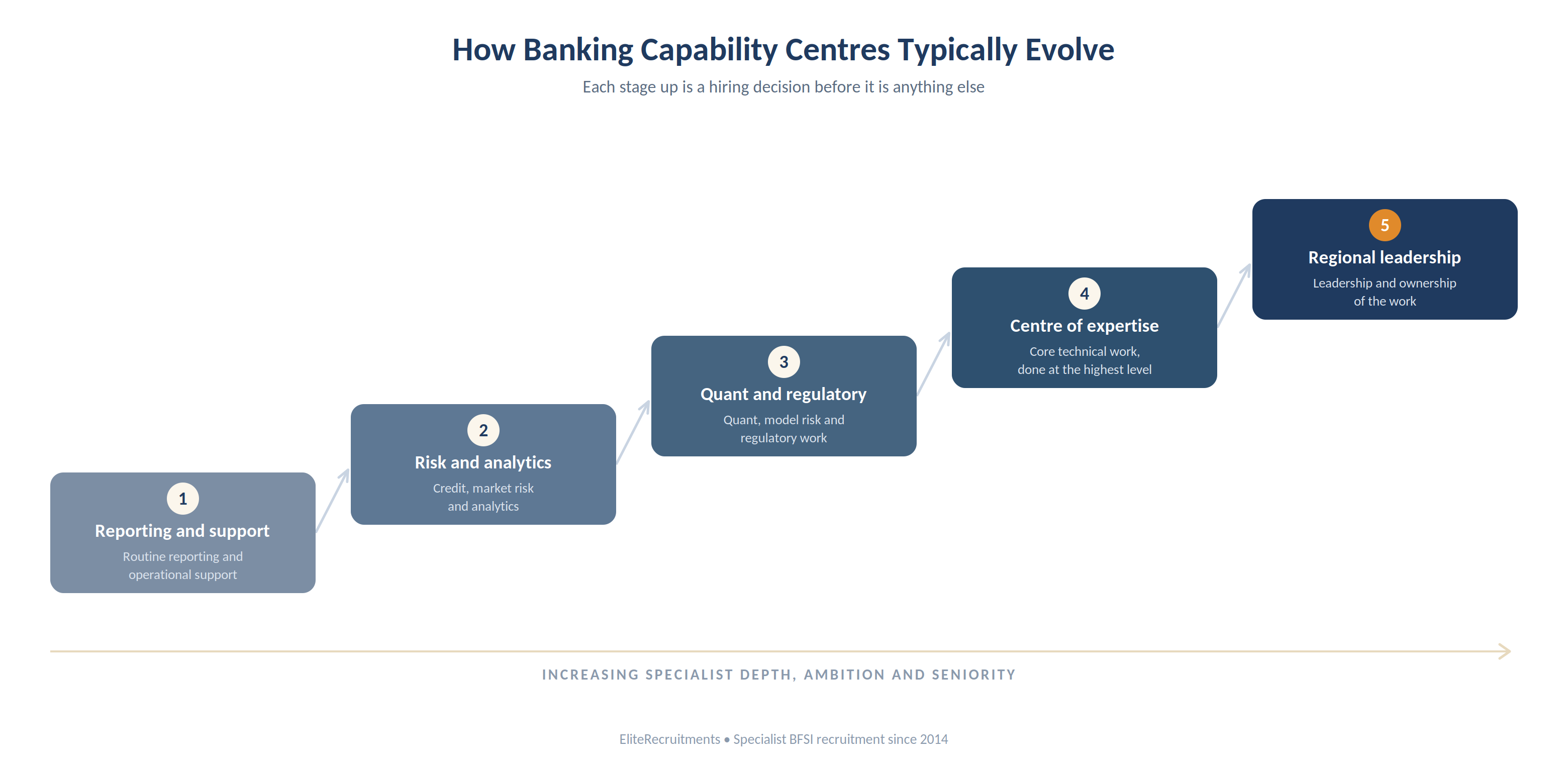
Banking capability centres rarely begin as centres of expertise. They tend to evolve through recognisable stages, from reporting and support, to risk and analytics capability, to quantitative, model and regulatory work, to a genuine centre of expertise, and in time to regional leadership. Moving up a stage is almost always a hiring question before it is anything else.
The shift
From cost saving to centre of expertise
The first generation of banking capability centres was built around efficiency. The current generation is built around expertise. Today, banks run credit and market risk modelling, model validation, quantitative analytics and regulatory work from India because the talent exists here and because these functions sit at the heart of how banks manage risk and meet regulation. The challenge is no longer moving work to India. The challenge is building a team capable of doing that work at the highest level. A centre built for efficiency can be staffed on volume. A centre built for expertise has to be built on the right specialists, the right leaders, and people who stay.
The future
The future of banking capability centres
Future demand is concentrating around the most specialist work: model risk and validation, climate and ESG risk, financial crime and fraud analytics, advanced analytics, quantitative and data science, and the regulatory change that never stops. As artificial intelligence becomes part of how banks model risk and detect crime, demand for people who can build and govern these models is rising fast. The centres that can attract and retain this talent will increasingly become centres of expertise rather than support functions, and that, once again, comes down to hiring.
How we help
How we help with banking capability centres
We help in two ways. Because the risk, quantitative and analytics work at the heart of banking GCCs is exactly where we are strongest, and India is our home market, this work sits squarely within our greatest strength.
Build or scale a centre
For banks building or scaling a capability centre, we build the team from the ground up, recruiting the anchor hires, the specialist risk, quantitative, analytics, regulatory and audit talent, and the leaders who hold it together.
See how we build banking teams in IndiaGrow an established centre
For banks with established centres, we recruit the specialist and senior talent they need to grow into deeper expertise.
Capability Build RecruitmentWhy banks work with us
Why banks work with us for India hiring
Banks work with us because we genuinely understand the technical work their India centres do, across risk, quant and analytics, because that work is exactly where our depth lies, and because our placements last. We assess on real capability rather than job titles, we screen at an 80 per cent rate, our candidates join at an 85 per cent rate, and since 2014 we have had to return fewer than fifteen fees because a placement left early, backed by our 90 day replacement guarantee. For a capability centre being built for expertise in disciplines this technical, that discipline matters more than anywhere. See how we work
Founder led
A founder close to the work

EliteRecruitments is led by its founder, Shagun Gupta, who built the firm in India on the risk, analytics and quantitative disciplines banking capability centres run on, and who stays closely involved in capability building engagements. For a bank building in India, that means a firm whose founder understands both the technical work and the market it is built in.
Common questions
Frequently asked questions
What work do banking capability centres in India do?
Why do banks build capability centres in India rather than elsewhere?
What is model risk management?
What skills are hardest to hire in banking capability centres?
Do you recruit for front office banking roles such as trading or origination?
Can EliteRecruitments help build a banking capability centre in India?
Do candidates pay any fees?
Start a conversation
India is where the world builds its banking capability
India is where the world increasingly builds its banking capability, and building it well comes down to hiring the right specialist talent across risk, quant and analytics. If you are building or scaling a banking capability centre in India, or hiring specialists for an existing one, we would like to help.
Thank you, we will be in touch shortly.
Your note goes to Shagun and the banking desk directly.