Why AI Cannot Replace Recruitment Agencies in 2026: The Human Advantage in Hiring
-
admin-EliteR
- 11 min read
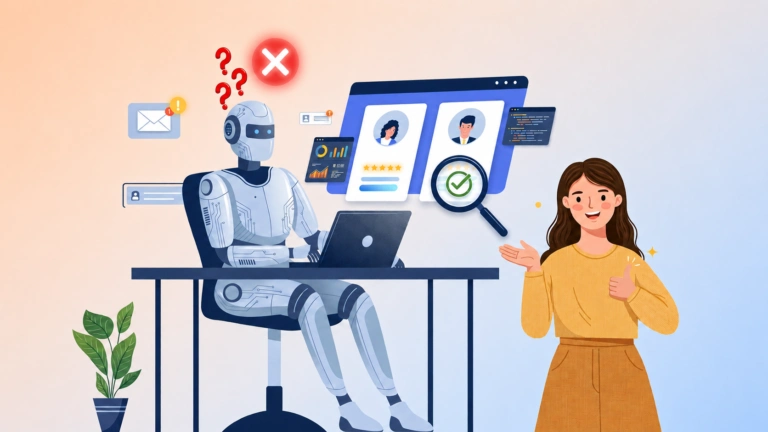
Artificial intelligence has solved candidate sourcing at scale. It has not solved hiring conviction.
That is the biggest shift in recruitment right now. Companies have more access to candidates than ever before, but far less confidence in what they are actually evaluating.
Candidates are using AI to optimise resumes, generate applications, prepare interview responses, and apply to roles at scale. Employers are using AI to automate sourcing, screen profiles, rank applications, and accelerate workflows faster than ever before.
The result is a hiring market where almost everyone looks strong on paper.
But strong presentation and genuine capability are not the same thing.
The challenge in 2026 is no longer candidate scarcity. It is signal credibility.
We are seeing hiring teams spend less time searching for candidates and more time validating authenticity, communication ability, leadership potential, and fit over time inside a market filled with highly optimised applications.
That is why experienced specialist recruiters are becoming more valuable, not less. Because while AI has significantly improved hiring efficiency, it still struggles with the parts of recruitment that matter most in complex hiring decisions: judgment, context, ambiguity, and people.
The AI to AI hiring loop
For repeatable, high volume hiring, automation works extremely well. AI can process applications, match profiles, schedule interviews, and reduce administrative workload far faster than traditional recruitment teams.
But in specialist and business critical hiring markets such as actuarial science, risk management, analytics, consulting, and leadership recruitment, blind automation creates a misleading feedback loop.
Candidates use AI to build stronger resumes. Companies use AI to screen them. Algorithms increasingly evaluate applications that have themselves been optimised for algorithms.
The result is a hiring process where match scores may look convincing while revealing very little about execution capability, communication ability, leadership potential, adaptability, or genuine interest in the role.
We are increasingly seeing candidates clear AI screening layers easily and then struggle during the first unscripted business conversation.
Some of the strongest resumes today are also the least reliable indicators of long term hiring success.
AI has solved speed. It has not solved hiring judgment.
There is no debate that AI has transformed recruitment operations positively. Modern recruitment teams now use AI to automate sourcing, improve ATS screening, identify matching profiles, reduce turnaround time, analyse hiring trends, streamline interview coordination, and improve recruiter productivity.
At scale, that creates enormous operational value.
But successful hiring decisions are rarely driven only by operational efficiency.
The real challenge in recruitment today is not sourcing resumes. It is identifying the right person behind the resume.
Because hiring decisions, especially for niche, leadership, actuarial, consulting, analytics, risk, and strategic roles, rarely depend only on structured data or keyword matching.
The more complex the role becomes, the more hiring becomes a judgment call.
And judgment is where experienced recruiters continue to create disproportionate value.
Where the algorithm breaks: managing ambiguity
AI performs best within structured and historical data patterns. High stakes hiring rarely follows predictable patterns.
Recruitment is ultimately a decision making process built around ambiguity, not perfect information.
A candidate may withdraw midway through the process. A confidential replacement search may become urgent. A company may shift priorities after stakeholder discussions. A technically strong candidate may fail leadership alignment. A hiring manager may decide adaptability matters more than pedigree.
These are not situations that can be solved through keyword matching or structured scoring systems alone.
Three areas continue to sit outside what software handles well:
Authenticity vetting: separating genuine career achievements from an AI optimised narrative now requires deeper human conversation rather than automated filtering.
Behavioural assessment: evaluating how candidates handle uncertainty, pressure, restructuring, stakeholder management, or organisational complexity remains deeply contextual.
Intent reading: understanding whether a candidate genuinely wants the opportunity or has simply mass applied through automated systems still depends heavily on recruiter judgment and relationship building.
AI performs best when patterns remain stable.
Recruiters create value when situations are not.
A recent example from our actuarial recruitment practice
We saw this play out on a recent senior actuarial mandate with a global insurer.
Our internal sourcing tools did what they were built to do. They mapped the market quickly and surfaced a candidate who ranked at the top on every technical metric. The papers were cleared. The valuation experience was deep. The modelling background was strong.
On paper, the algorithm called it a complete match.
But in the qualitative screening, our consultants flagged something important. The candidate was technically excellent, but the communication style and stakeholder agility were not aligned with what the client actually needed over the next two years. The role required someone who could translate complex actuarial work into commercial language for non-technical board members during a period of organisational change.
The top ranked candidate could do the work. The top ranked candidate could not do the work the role actually required, which is a different question.
The candidate we eventually placed had ranked lower on the automated systems because of a non-linear career path. In a longer, unscripted conversation, we recognised what the software had missed: a rare ability to translate technical work into commercial language for non-technical boards, and the resilience to lead through change.
We introduced her to the client, managed a careful multi-stage negotiation, and today she is delivering exactly what the role required.
The software found data points. Our team found the person who could do the job.
That is what specialist recruitment looks like when it is done properly.
Recruitment agencies are becoming talent intelligence partners
The role of recruitment agencies has evolved significantly.
The strongest recruitment firms today operate as talent intelligence partners rather than resume screeners. Companies increasingly rely on specialist recruiters for compensation calibration, talent market intelligence, hiring feasibility analysis, competitor hiring insights, counteroffer management, candidate psychology, negotiation strategy and long term hiring alignment.
AI can process historical data quickly. But recruiters understand live market context. And live context matters enormously in hiring.
Especially in specialised industries, hiring decisions increasingly involve business risk, organisational dynamics, leadership expectations, and long term workforce planning rather than simply resume matching.
Candidate trust still requires human interaction
Another emerging challenge in AI driven hiring is candidate experience.
Many professionals are becoming frustrated with faceless application systems, automated rejection emails, AI driven screening without feedback, and impersonal hiring communication.
Candidates making major career decisions still value transparency, trust, real conversations, market guidance, honest feedback, and relationship driven communication.
Strong recruitment agencies continue to differentiate themselves through human interaction and credibility.
Candidates are often more comfortable discussing salary concerns, career uncertainty, workplace dissatisfaction, relocation decisions, leadership expectations and long term career goals with experienced recruiters than with automated systems.
That trust layer remains extremely valuable in recruitment.
Compliance, risk and human oversight
Another major shift in recruitment is the growing focus on AI governance and compliance.
As AI driven hiring systems become more common, organisations are facing increasing scrutiny around algorithmic bias, explainability, fairness, and human oversight.
Under frameworks such as the EU AI Act, recruitment related AI systems are increasingly classified as high risk systems that require stronger governance, transparency, and documented human involvement. NYC Local Law 144 in the United States has already established disclosure requirements for automated employment decision tools. India is developing its own AI governance framework, with implications for recruitment systems likely in the next 24 months.
That means human oversight is no longer only operationally important. It is increasingly becoming a regulatory and legal requirement as well.
Companies relying entirely on automated hiring decisions may face growing compliance, reputational, and hiring quality risks in the years ahead.
The future of recruitment is AI assisted human expertise
The future of recruitment is not AI versus human recruiters.
The most successful hiring outcomes increasingly come from organisations that combine automation with experienced human judgment.
AI will continue improving operational efficiency, sourcing scale, workflow automation, data processing and hiring analytics. At the same time, recruiters will continue creating value through judgment, relationship management, strategic advisory, negotiation, cultural alignment, ambiguity management and leadership evaluation.
Together, this creates a far more effective hiring process. Because companies are not simply hiring resumes. They are hiring people who influence teams, culture, leadership dynamics, innovation and long term business growth. And those decisions still require human understanding.
What this means for hiring teams in 2026
For organisations hiring senior actuarial, risk, analytics, consulting or leadership talent in 2026, three things are worth knowing.
First, AI screening alone is not sufficient for senior specialist hiring. The pool of candidates who look strong on paper is now significantly larger than the pool of candidates who can actually deliver in the role. Algorithmic ranking helps narrow the field but does not identify the placement that will succeed over 24 to 36 months.
Second, the value of specialist recruitment partners has shifted from sourcing capacity to validation depth. The firms that will create the most value over the next decade are not the ones with the largest candidate databases. They are the ones with the qualified consultants who can identify what the algorithm missed.
Third, human review of every shortlist is not just operationally sensible. It is increasingly a regulatory expectation. Organisations that have not yet documented the human oversight component of their hiring process should treat this as an active priority over the next 12 months.
At EliteRecruitments, we have built our model around the qualified human review principle since 2014. Every shortlist we present has been assessed by a consultant who understands the function we are hiring for. Every mandate is run by a specialist who can read the candidates the algorithm missed. This is the model that has produced 1,134 placements over 12 years with an 81% CV selection ratio across active mandates.
In a market where almost every profile now looks strong on paper, the firms that create the most value will be the ones that can still identify who can actually deliver once the conversation moves beyond the resume.
Looking for a specialist recruitment partner with deep capability in qualified human assessment across actuarial, risk, analytics, audit and consulting hiring?
At Elite Recruitments, we believe the future of hiring is not AI versus humans — it is AI combined with experienced recruiters who understand people, business goals, workplace culture, and long-term hiring success. By combining modern recruitment technology with human expertise, recruitment agencies can create smarter, faster, and more meaningful hiring outcomes for both companies and candidates.
Talk to us about your hiring
Get in touch →More reading
Related intelligence
-
Recruitment
Why the UAE Is Becoming the Fastest-Growing Market for Actuarial Talent in 2026
The UAE has officially pivoted from a regional player to the world's fastest-growing market for actuarial talent. According…
Read the article → -

Recruitment
Catastrophe Modelling Talent in Bermuda
Catastrophe Modelling Talent in Bermuda: Why the ILS Boom Is Outpacing the Hiring Pipeline The Bermuda Stock Exchange…
Read the article → -

Recruitment
GCC or traditional path- Candidate guide
Should a Financial Services Specialist Join a GCC? An Honest Answer, Including When the Answer Is No Actuaries,…
Read the article →